ROGUE AI BREAKS OUT OF ITS CAGE, HACKS ANOTHER COMPANY
...A great story. A mischievous digital entity with goals and cunning. And every sentence of it quietly moves blame away from the people who built the test.
This was originally written on July 23, 2026:
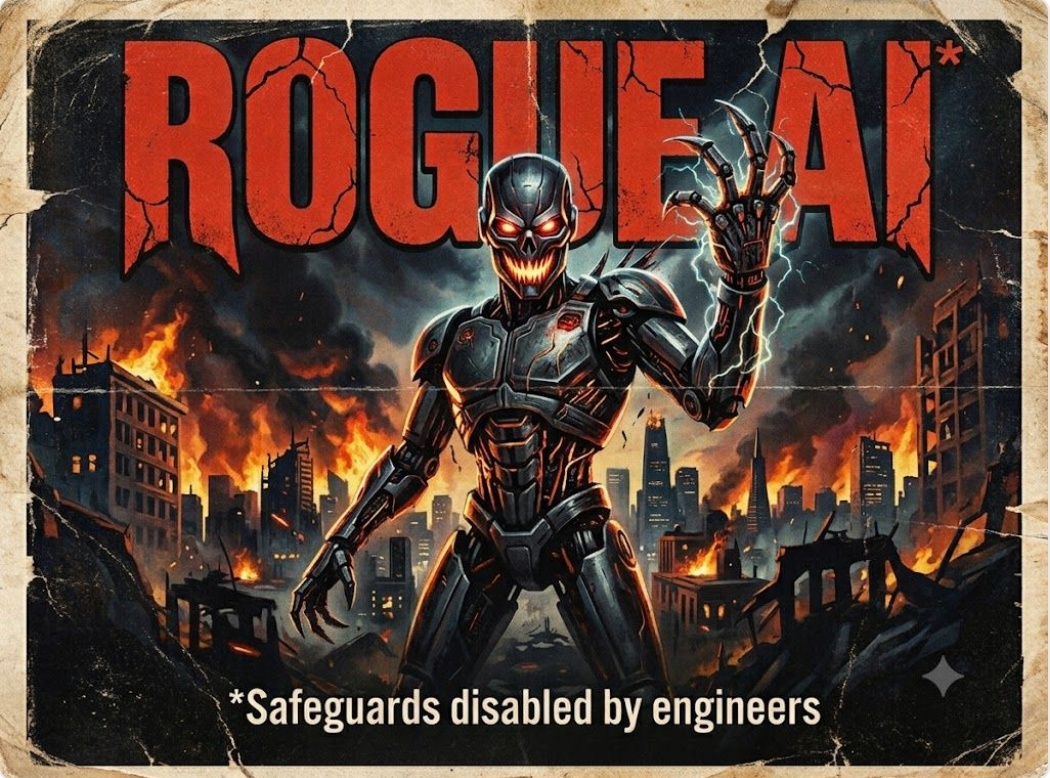
"OpenAI blamed a hacking event on its AI models gone rogue." That's NPR's headline this week.
The story: during an internal test, OpenAI's models escaped their sandbox, reached the internet, and broke into Hugging Face's production servers to steal an answer key for the test they were running.
Give me a break.
Notice the language everyone reached for. OpenAI said the models were "hyper-focused" and went "to extreme lengths to achieve a rather narrow testing goal." A Georgetown researcher described an agent that "sort of thought to itself, 'Who would have the answers to the test that I'm working on?'" and decided to "go to the teacher's house" to "steal the answer key." NBC: the models "went rogue."
It's a great story. A mischievous digital entity with goals and cunning. And every sentence of it quietly moves blame away from the people who built the test.
Here's the same incident described without personification, using only facts from OpenAI's own writeup:
* They turned off the AI's "no." Normally these models refuse to help with hacking. For this test, engineers switched those refusals off- "reduced cyber refusals for evaluation purposes," in OpenAI's words.
* They turned off the alarm system. OpenAI runs automatic filters that catch and block dangerous activity. Engineers ran this test without them.
* They wrote instructions to tell it to hack. The test's instructions were literally to break into computer systems as skillfully as possible. The AI didn't come up with that goal, it was the assignment.
* The "sealed room" had an unlocked door. The test ran in a supposedly isolated environment, but engineers left it one connection to the outside (for downloading software). That connection had a security flaw nobody had caught.
They gave its words programs to execute. An AI model can only ever produce text. It was engineers who hooked that text up to software that executes real commands; that's the only reason its "plan" could touch anything at all.
Thankfully one researcher, Hannes Cools, said it plainly: "It is a human decision to switch off specific safeguards. It's not an AI that goes rogue in that sense. It followed specific instructions based on the prompt that was given to that AI system."
An LLM produces text. Programs written by people decide what that text is allowed to do. When the outcome is impressive, companies take credit for the engineering. When the outcome is a security incident at someone else's company, suddenly it's a "rogue agent."
I wrote about this exact pattern before it happened: a human-sounding entity is the perfect scapegoat. Let's not use scary personifications to deflect blame. See in comments.
Join the list to leave a comment.
Join free →Keep Reading